Telus Raised Roaming to $18/Day and Nobody Noticed for Five Months. Here’s What Your Italy Trip Costs Now.
The new rate went live on a Thursday in October with no press release and no customer email. It took a reporter checking the Wayback Machine to notice. If you fly to Italy this fall on Telus, Koodo, Rogers or Fido, the phone in your pocket is now a $252 liability for a two-week trip. Here is the full math, and the three legal ways to pay a fraction of it.
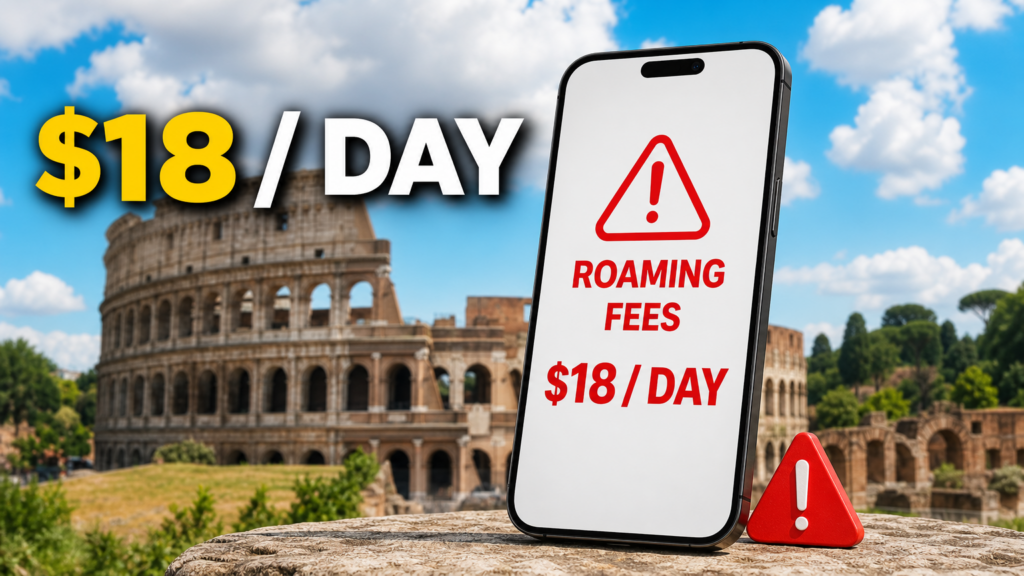
Your flight from Montreal lands in Rome at 8:45 in the evening. You switch your phone off airplane mode while still taxiing to the gate. iCloud Photos starts syncing, your banking app pings a server, a WhatsApp message arrives and refreshes. None of that took more than a megabyte. On a Telus line, it just started an $18 Easy Roam day.
Here is the part almost nobody knows. That $18 rate is new. Telus changed it on its website on October 2, 2025, quietly, from $16. No press release, no announcement email, no mention in anyone’s bill. The change sat undiscovered for five months, until MobileSyrup caught it on March 3, 2026 by comparing archived versions of Telus’s pages in the Wayback Machine. In between those two dates, every Telus and Koodo subscriber who flew to Europe paid the new rate believing it was the old one.
I have spent the last week pulling the current rate cards for every major Canadian carrier, the billing rules that multiply the damage, and live Italy eSIM prices. This is the reference I wish existed before my last trip: what your Italy trip actually costs now, why the bill lands higher than you expect, and what to do about it before you board.
The hike nobody announced
First, what changed. Easy Roam is Telus’s default roaming add-on: a flat daily fee that lets you use your Canadian plan abroad. On October 2, 2025, Telus raised it from $16 to $18 per day for international destinations (which includes Italy) and from $14 to $16 for the U.S., according to MobileSyrup’s archive sleuthing. The only trace of the change at the time was a small note on Telus’s own website nudging customers toward pricier plans and travel passes. Telus’s travel page even carries the clause that made the silence legal: “Easy Roam is a pay-per-use feature subject to change without notice, including coverages, rates and usage guidelines.” (That wording was live on telus.com as of January 2026.)
Contrast that with Rogers. When Rogers raised its identical Roam Like Home rate to $18 on August 7, 2025, it at least posted a notice on the Rogers and Fido websites, and Canadian tech press covered it within days. Telus changed the same number on a quiet Thursday and said nothing.
The hikes also run directly against what Canada’s telecom regulator asked for. In October 2024, the CRTC publicly urged Rogers, Bell and Telus to make roaming more affordable and threatened a proceeding if progress was insufficient. The Big Three responded that their rates were already competitive. Since then, Rogers hiked twice in 2025 and Telus followed with its stealth increase. For context on how far the price has drifted: Rogers charged $10 per day internationally in 2017, and its roaming product launched in 2014 at $5 per day in the U.S.
And the fallout is measurable. The telecom complaints ombudsman, the CCTS, accepted 19,157 complaints between August 2025 and January 2026, up 61 percent from the same period the year before, with billing the top concern and roaming charges named one of the drivers of the wireless-complaint surge. Rogers/Shaw alone drew 34 percent of all complaints. The new roaming rates and the complaint spike landed in the same window.
The 2026 rate card, verified
This is where every major Canadian carrier stands for a trip to Italy as of August 2026. Daily rates are pre-tax; Quebec adds roughly 15 percent (GST and QST), and carrier pages state taxes are extra.
| Carrier | Daily rate (Italy) | How a “day” is billed | Per-cycle cap | Europe pass option |
|---|---|---|---|---|
| Telus Easy Roam | $18 | Until 11:59 pm in the local time zone | $400 intl / $350 US1 | 14-day Europe pass, listed at $502 |
| Koodo Easy Roam | $18 | Same Telus-style daily add-on | No automatic cap per third-party trackers | 14-day pass $503 |
| Rogers Roam Like Home | $18 | Calendar day in your home billing time zone | 20 days/cycle ($360 max) | Europe pass $70/14d, $80/30d |
| Fido Roam Daily | $18 | Calendar day | 20 days/cycle ($360 max) | Same passes as Rogers |
| Bell Roam Better | $16 | Calendar day; throttled to 512 Kbps after 5 GB/day | 20 days/cycle ($320 max) | Europe pass $70/14d (text EURO7) |
| Videotron Daily Traveller | $15 | True 24 hours from first use4 | 20 days/cycle (~$300 max) | n/a (daily only) |
The headline inversion: Bell, the carrier that started Canada’s roaming price wars, is suddenly the cheapest of the Big Three, because it is the only one that stopped raising prices. And Videotron, the Quebec carrier most Montreal readers already know for home service, undercuts everyone with the fairest clock in the business: pay at 5 pm in Florence, and your day runs until 5 pm the next day, not until midnight.
What your Italy trip now costs
Assume you use your phone every day of the trip, which for maps, tickets and photos is the realistic assumption. Pre-tax figures; add ~15 percent in Quebec.
| Trip length | Telus / Koodo / Rogers / Fido ($18) | Bell ($16) | Videotron ($15) | Italy eSIM (10 GB, 30 days) |
|---|---|---|---|---|
| 7 days | $126 | $112 | $105 | ~$15 |
| 10 days | $180 | $160 | $150 | ~$15 |
| 14 days | $252 | $224 | $210 | ~$15 |
| 21 days | $378* | $336* | $315* | ~$23 (20 GB) |
Put differently: the stealth $2 increase is $28 extra on a two-week trip, or about $32 with Quebec taxes, per person, per phone. A family of four with four active lines absorbs over $120 of it. That is a dinner in Trastevere, paid to a carrier for changing a number on a webpage.
Why the bill lands higher than you expect
The daily rate is only half the story. The billing mechanics do the rest, and Telus publishes every one of them on its own travel page.
The trigger bar is equally low. Per Telus, a daily fee starts when you use data, send a text, make or answer a call, or check voicemail. iMessage and picture messages count as data. So does anything that wakes the cellular radio in the background: iCloud Photos, OneDrive, app updates, a Find My ping. The most common surprise charge lands on arrival day, before the traveler has consciously opened a single app.
Three more mechanics worth knowing:
Incoming texts are free. Receiving an SMS does not activate Easy Roam, Telus confirms. This matters for the fix below: you can keep your Canadian line alive for bank two-factor codes at zero cost, as long as its data roaming stays off.
The “protection” cap is frozen. Telus limits Easy Roam charges to $400 per billing cycle internationally ($350 U.S.). That ceiling was set when the daily rate was lower, so the hike silently shrank it: $400 used to mean 25 days of roaming, now it means about 22. Rogers and Bell cap at 20 days instead. A long trip that crosses two billing cycles can start the daily charges all over again.
Taxes are extra. The $18 is pre-tax. In Quebec, GST plus QST takes a two-week Easy Roam habit from $252 to about $290.
What to do instead
Lane 1: If you want to keep roaming, buy the pass your carrier buries
Every carrier sells a discounted travel pass that most customers never see, because the daily rate is the default. Telus and Koodo list a 14-day Europe pass around $50. Rogers and Fido sell a 14-day Europe pass for $70 and a 30-day for $80. Bell’s 14-day Europe pass is $70, activated by texting EURO7. These are still pricier than an eSIM, but they cut a $252 bill to $50-$70 with zero changes to your phone. Search “travel pass” in your carrier app before you fly; availability varies by plan, and pass prices change, so confirm the number on screen before you buy.
Lane 2: The eSIM route (what most experienced Italy travellers now do)
A travel eSIM is a second, data-only line you install before departure by scanning a QR code. It runs your data in Italy for a fixed, prepaid price while your Canadian number stays in the phone for calls and texts. Current Italy prices checked August 2026: Jetpac 10 GB/30 days at US$11 (~$15 CAD), Airalo 10 GB/30 days at US$24 (~$33 CAD), Nomad 10 GB at US$19 (~$26 CAD), Holafly “unlimited” 14 days at US$47.90 (~$66 CAD, with a fair-use throttle and 1 GB/day hotspot cap). All are dramatically cheaper than any daily roaming rate, per Traveltomtom’s August 2026 price survey.
The setup that avoids every mystery charge, in five steps:
- Buy the eSIM at home, 3 to 7 days before departure, on Wi-Fi. eSIM installs need an internet connection and are easiest done before you leave.
- Install and label it. iPhone: Settings, Cellular, Add eSIM, scan the QR. Android: Settings, SIMs, Add eSIM. Label the new line “Travel”.
- Point data at the Travel line and turn Allow Cellular Data Switching OFF. That toggle is the one that quietly fails your data back to the Canadian SIM when the eSIM signal dips, which is exactly what triggers accidental $18 days.
- Turn Data Roaming OFF on your Canadian line only. Voice and SMS keep working, so bank 2FA texts still arrive, and incoming texts do not activate Easy Roam.
- Turn the Travel line’s data on when you land. It attaches to an Italian network (typically Vodafone, WindTre or Iliad) within a minute. Total roaming cost: zero.
Lane 3: The Quebec option most people forget
If you are Montreal-based and this math has you annoyed, Videotron’s Daily Traveller Pass charges $15 per day internationally and is the only major Canadian pass billed in true 24-hour windows from first use, capped at 20 days per cycle. It is still daily roaming and still pricier than an eSIM, but it is the fairest version of the product that exists here, and it removes the midnight-reset trap entirely.
For stays of three weeks or more, there is a fourth door: Italian carriers sell tourist plans in-store that eSIM listicles rarely mention. As of 2026, TIM offers 100 GB for 30 days at €14.99 (plus €10 activation), WindTre 70 GB at €14.99 with no activation fee, and Iliad 200 GB at €9.99 per month (plus a €9.99 registration), all requiring your passport at purchase. That is the cheapest data in this whole article, in exchange for a stop at a phone shop.
When daily roaming is still the right call
For balance: a one or two-day stopover makes the daily fee almost defensible ($18-$36 versus the setup effort), corporate-managed lines sometimes require carrier roaming for billing reasons, and phones without eSIM support (most devices before 2018 and many flip phones) leave roaming or a physical Italian SIM as the only options. For everyone else taking a real Italy vacation this fall, the math points one way.
The bottom line
Telus raised its international roaming rate to $18 a day on October 2, 2025, told no one, and went unreported for five months. Koodo followed to the same rate, Rogers and Fido were already there, and Bell’s refusal to move made it the accidental bargain of the Big Three. Two weeks in Italy now costs $252 before taxes on four of the six networks, and the calendar-day clock means the first charge often lands before you leave the airport. Check your carrier’s rate today, not on the arrival jet bridge: the difference between doing nothing and buying a $50 pass or a $15 eSIM is the difference between a phone bill and a train ticket to Cinque Terre.
Sources and verification
- MobileSyrup, March 3, 2026: Telus raised Easy Roam to $18 international / $16 U.S. on October 2, 2025, identified via the Wayback Machine; CRTC urged cheaper roaming in October 2024.
- iPhone in Canada, July 14, 2025, alongside MobileSyrup’s July 2025 coverage of the Rogers/Fido hike: Rogers/Fido to $18 international on August 7, 2025; Rogers 2025 price history ($15 in Feb, $16 in Mar, $18 in Aug) and 2014 launch price; Bell at $13/$16; Rogers and Bell Europe travel-pass prices.
- Telus travel page (archived January 14, 2026): $18/day international confirmed; activation triggers; 11:59 pm local time-zone billing; incoming texts free; iMessage counts as data; “subject to change without notice” clause.
- WhistleOut and r/telus customer reports: Telus Easy Roam caps of $350 (U.S.) and $400 (international) per billing cycle.
- Bell Roam Better FAQ: $16/day international, 20-day cap applied per region.
- Videotron Daily Traveller Pass: $15/day international, 24-hour billing from first use.
- CCTS Mid-Year Report, April 29, 2026: 19,157 complaints Aug 2025 to Jan 2026, up 61 percent; billing the top concern; roaming named among drivers of wireless complaint growth.
- Traveltomtom, updated August 2026: Italy eSIM and local tourist-SIM prices (Jetpac, Airalo, Nomad, Holafly, TIM, WindTre, Iliad).
- r/Rogers thread on the August 2025 hike: “This program launched in 2014 at $5 a day for roaming in the USA. With inflation it should be at most $7 in 2025 and they are increasing it to $16 a day.” (35 points, 70 comments.)
- Currency conversions (USD ~1.37 CAD, EUR ~1.61 CAD) are approximate mid-August 2026 values; roaming prices exclude taxes.